KEPA GARRAZA: ART AS A MEDIA
03.11.2026
Who deserves to be put on a pedestal?
<<The echoes from the cave we thought we had left behind remind us that light does not always truly illuminate.>>
Kepa Garraza (Berango, Vizcaya, 1979) is a Spanish painter known for reflecting on the nature of the images we consume every day, as well as for reinterpreting reality in a way that is full of subtleties and gray areas, inviting the viewer to rethink the historical narrative and the chronicle of reality.
In Metal Magazine, we'll find an interview in which Kepa talks about his routines, the media, fiction, AI, and one of his great passions: history.
This was done in connection with his new exhibition, The Architecture of Power.
We live in a world where we are constantly surrounded by events, images, and news that unfold nonstop. Faced with this society, Kepa uses a medium that requires time, concentration, and reflection to convey ideas directly related to this world of immediacy, creating a contrast between what he depicts and the source from which it originates. In the interview, he explains how this society of immediacy and hyper-acceleration—in which information circulates at such a rapid pace—is one of his greatest challenges when deciding what to depict in his works.
“My work has always explored that fine line between what is real and what is fake.”
This information overload we mentioned earlier influences his creative process; Kepa explains how the media he uses to stay informed on a daily basis have changed significantly in recent years—a transformation his generation has experienced firsthand— how he started by getting his news from newspapers and television and has ended up relying on all kinds of podcasts while he works, since he feels they offer a degree of creative freedom and a format that is lacking in the mainstream media; and although he still turns to the mainstream media, he insists on the need to verify the information presented. What this makes clear to us is that information is a source of inspiration, but also a realm that demands a critical eye—especially given the information overload we face today.
Protester IV, compressed charcoal on paper, Kepa Garraza, 2023.
“Basically, I'm reflecting on a hyper-accelerated reality—which is the reality of the 21st century—using tools from the 17th century.”
Kepa is an artist fascinated by history; although he draws inspiration from contemporary events, history is one of his primary tools for interpreting them. Current conflicts, power struggles, and political narratives find echoes in historical events. His interest in classical painting and the great masters of the past stems not only from aesthetic considerations but also from a desire to understand how historical narratives have been constructed and transmitted. Through traditional painting techniques, the artist addresses contemporary themes that spark a dialogue between eras that seem distant from one another; yet, because they can be explained not only through the same mediums but also through the same form of expression, it becomes clear that they are not as far apart as society would have us believe. His works invite us to reflect on how certain mechanisms of power, social conflicts, and strategies of representation remain relevant despite the passage of time.
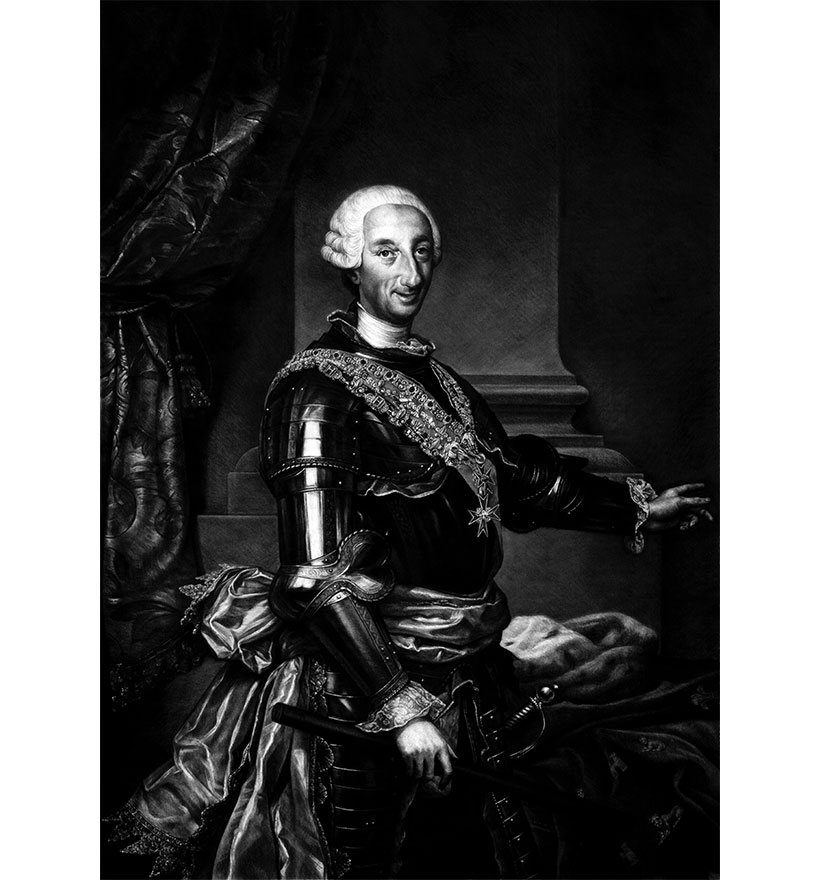
Carlos III, compressed charcoal on paper, Kepa Garraza, 2023.
In the interview, he discusses his project New Monumentalism, which is based on the transformation of historical monuments by replacing their central figures with anonymous or anti-establishment figures, while maintaining the same visual codes of authority, hierarchy, and domination. Kepa does this because he observes that cities are filled with works designed to legitimize power, which have become so normalized among the public that few people stop to think about what these figures truly symbolize. Kepa states in the interview: “…it would be a rather ironic interpretation of the function of this type of monument in public space, which has always been the same: to demarcate and represent power.” He says this because of the irony inherent in his work; by featuring this anonymous hero, the artist does not present him as a symbol of hope—since he continues to employ violence and repression—but rather shows us how even an anti-establishment figure can be perceived as authoritarian when dressed in the right guise, thereby demonstrating the influence that a visual work can wield.
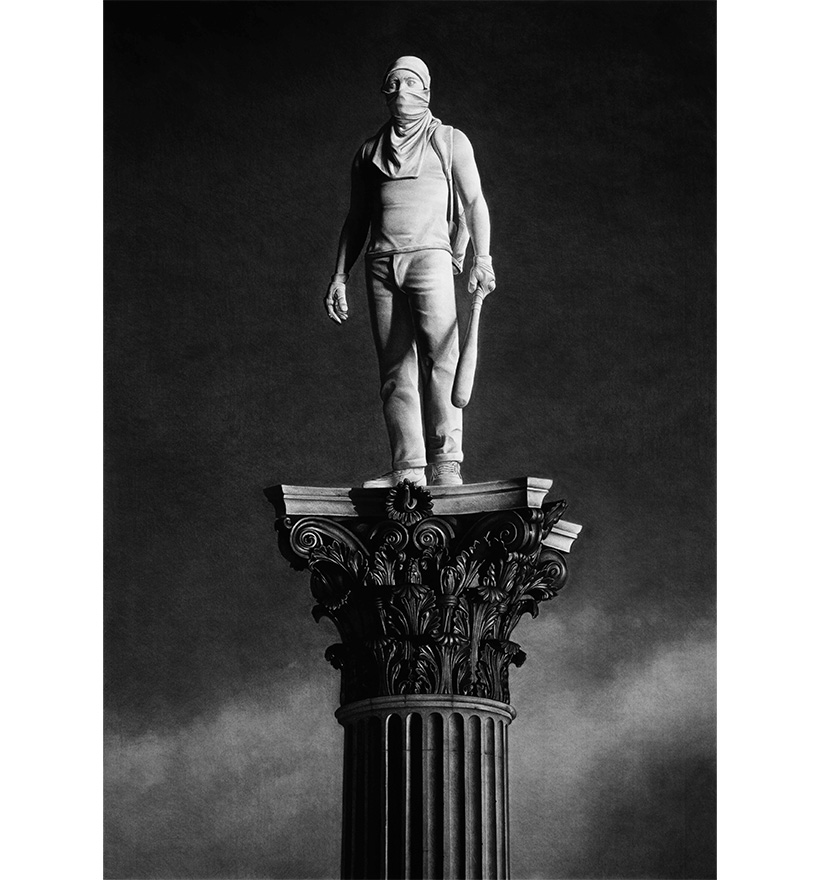
Proposal for monument 5 (Trafalgar Square, London), compressed charcoal on paper, Kepa Garraza, 2023.
Not only that, but the artist also draws comparisons to social movements such as Black Lives Matter, in which monuments in the United States were torn down because of what they represented and the figures they were honoring—which leads us to ask: Who truly deserves to be on a pedestal? Do we, as a society, have the right to choose who is there and why?
Art allows us to pause, reexamine established narratives, and question what we take for granted as true.
To watch the full interview, click here.



