
Additional information
| Artista | Kepa Garraza |
|---|


| Artista | Kepa Garraza |
|---|
This project invites the viewer to reflect on the function of the public monument within the urban environment, as
well to consider questions related to the representation of power and authority in our collective imagination. To this
end, I have devised a game of substitution that invites the viewer to rethink concepts related to the very nature of
the monument, its raison d’être and its usefulness.
My proposal is simple: to elaborate a series of models for imaginary sculptures that will never be made, but which
are proposed as fictional alternatives to a certain typology of statues very common in the public space: the portrait
of figures that symbolize the present and past power, in the form of portraits of monarchs, and a wide spectrum of
military, political, social or religious leaders. This type of representation of power structures, personified in those
who have exercised or executed it, is a common component of urban spaces and we can find countless examples
of such monuments throughout cities around the world. While such monuments commemorating authority and
power seem to be vestiges of the past, their prevalence in public space raises very interesting questions about how
we perceive them and how we live with them.
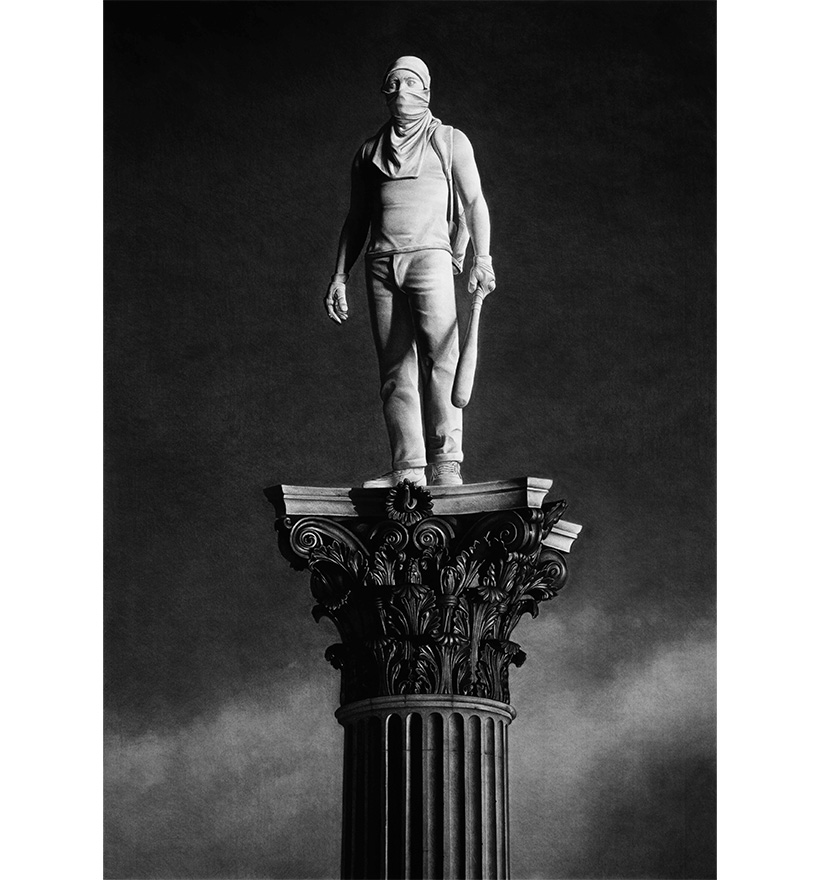
Taking these questions as a starting point, I have created a group of works that recreate imaginary sculptures. These
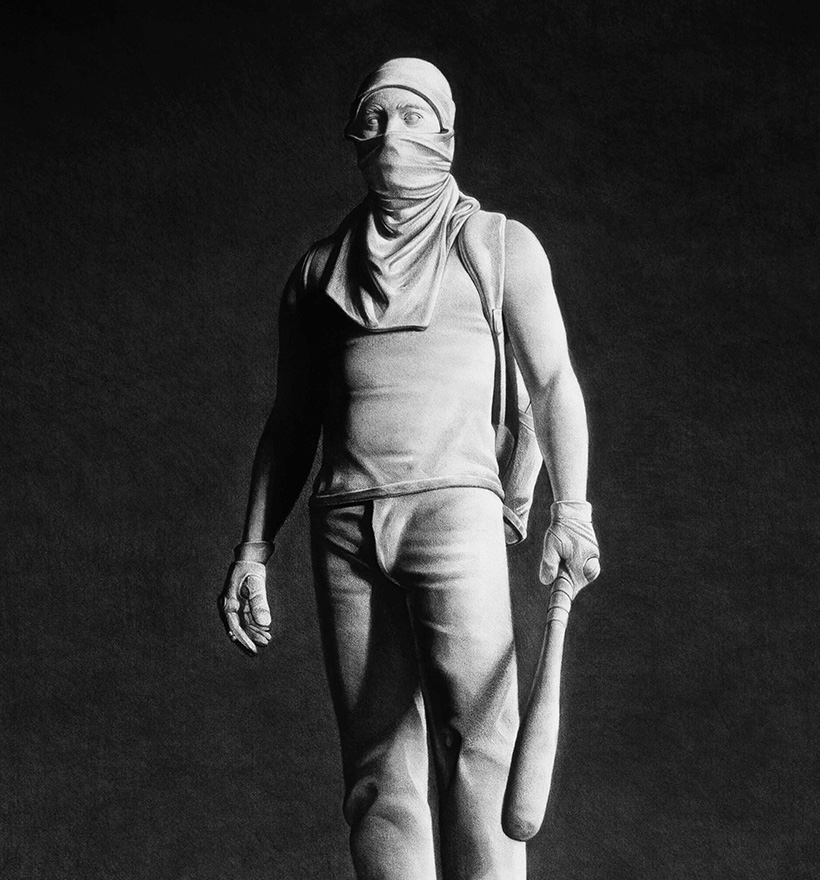
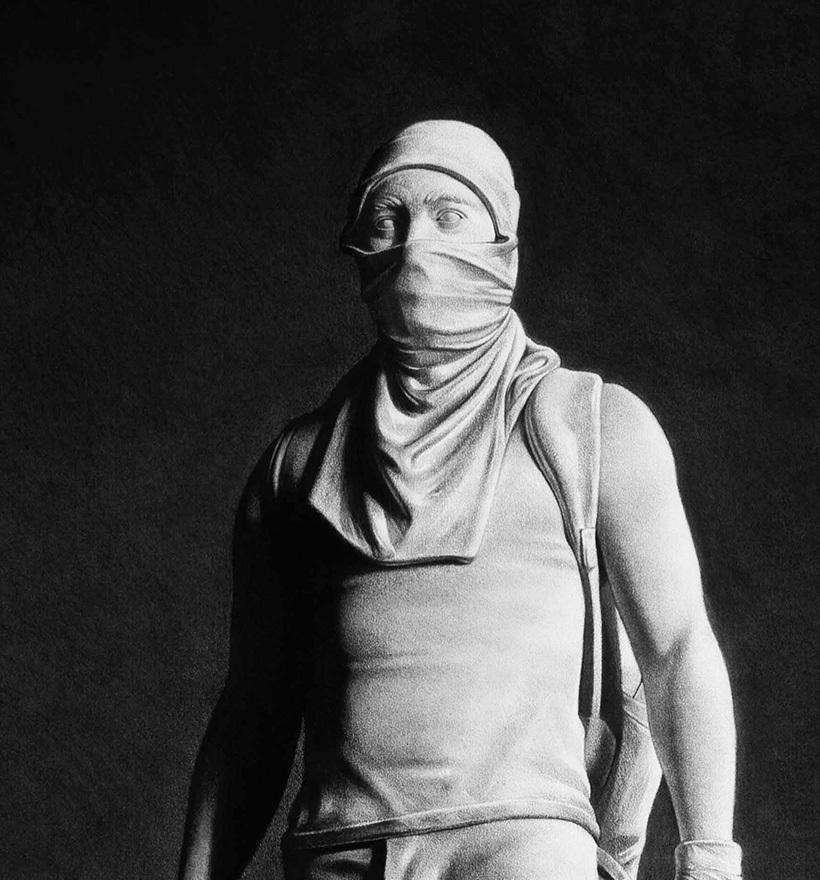
fictional sculptures show us different scenes, from hooded demonstrators carrying Molotov cocktails to others
confronting the police or holding protest banners. All these sculptures have been generated by 3D digital
modeling, obtaining virtual models that allow me to play with the scale, finish, texture and lighting. These fictitious
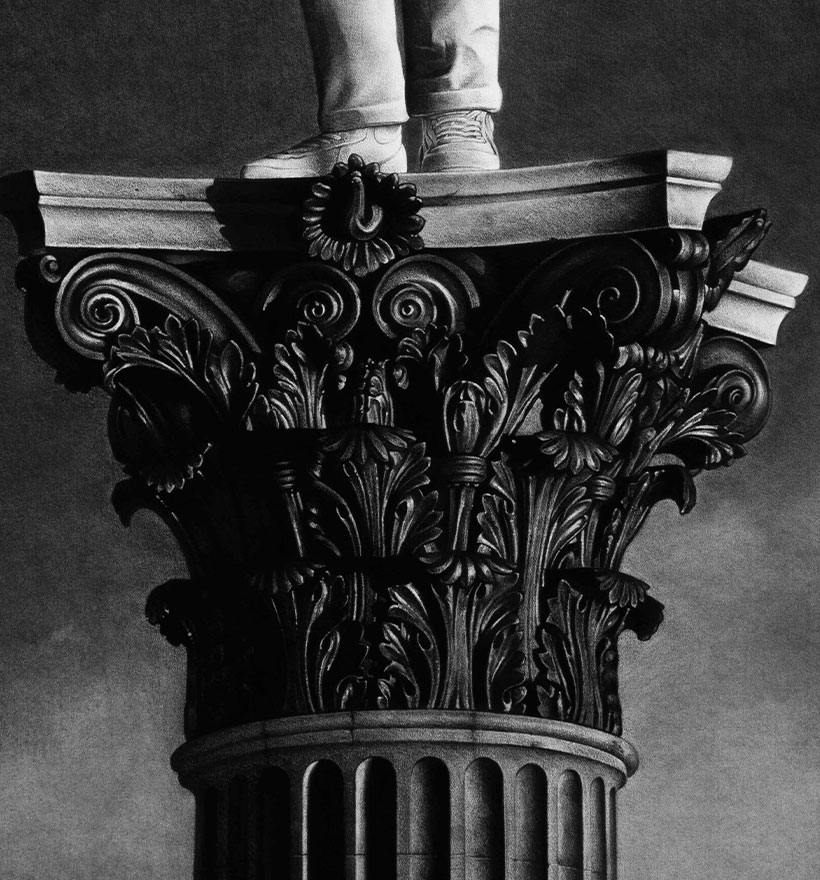
sculptures are introduced in well-known public monuments, replacing the figures of leaders, generals or kings. This
exercise of supplanting affects only the portrait of the figures of power, keeping unaltered the rest of the
architectural structures that are part of the original monument. Some of these scenarios are easily recognizable, as
in the case of the Lincoln Memorial in Washington D.C., where the famous sculpture of the seated President Lincoln
has been replaced by a monumental statue of a hooded man carrying a baseball bat in a threatening attitude.
I have also created a second group of works, where these fictitious sculptures are presented on a black background
and with very contrasting lighting. These works are conceived as a kind of preparatory studies, where I test
different solutions related to the finish of the works and their lighting.
My intention with this project is to present a kind of simulacra that invite the viewer to question concepts related to
the role and function of the monument in the public space and to consider the close relationship between art,
power and propaganda. These fictional variables are not presented as possible or desirable alternatives, but as a
kind of parody of the personification of power and authority. Furthermore, they want to invite us to rethink
questions related to the representation of violence and the symbolism used to represent a certain type of authority,
be it political, military or religious. As they are conceived as parodies, these works present us with attributes very
similar to the originals they are intended to replace, they show an antiquated aesthetic and at no time do they
appear as interesting alternatives. Somehow, they are presented as scenarios of a parallel reality where the portraits
of the powerful have been replaced by those of anonymous heroes. Perhaps the protagonists of a revolutionary
process that, as so often throughout history, seem incapable of offering an alternative to the classic ways of
exercising and representing authority and power
— Kepa Garraza.


